






- First, understand what highly selective universities evaluate
- Grade 8: Build the foundations
- Grade 9: Adjust well and begin observing patterns
- Grade 10: Move from participation to deeper engagement
- Grade 11: Build the strongest academic year
- The summer before Grade 12: Prepare without rushing
- Grade 12: Present the student clearly and honestly
- What parents should avoid
- The parent’s role changes each year
- How LilacBuds supports families through the journey
- Frequently asked questions
For families considering Ivy League, the admissions process can appear to begin in Grade 12.
In reality, a strong application develops gradually.
It grows through the subjects a student chooses, the interests they explore, the responsibilities they accept and the way they use the opportunities available to them. This does not mean turning every school year into an admissions exercise. Nor does it mean deciding a child’s career in middle school.
The parent’s role is to help the student build strong foundations, make informed choices and avoid last-minute pressure.
Here is a practical roadmap from Grade 8 to Grade 12.
First, understand what highly selective universities evaluate
There is no guaranteed route into an Ivy League university.
Academic performance remains central. Yale, for example, describes the high school transcript as the most important document in its application review and looks for students who have performed well across a broad range of challenging courses. Harvard similarly states that there is no admissions formula and that it considers academic achievement alongside community involvement, leadership, extracurricular distinction and personal qualities.
Universities also consider the context in which the student studied. They look at the courses offered by the school, the opportunities available and how the applicant used those opportunities.
The objective is therefore not to copy another successful applicant. It is to help your child develop an academic and personal record that reflects genuine effort, curiosity and growth.
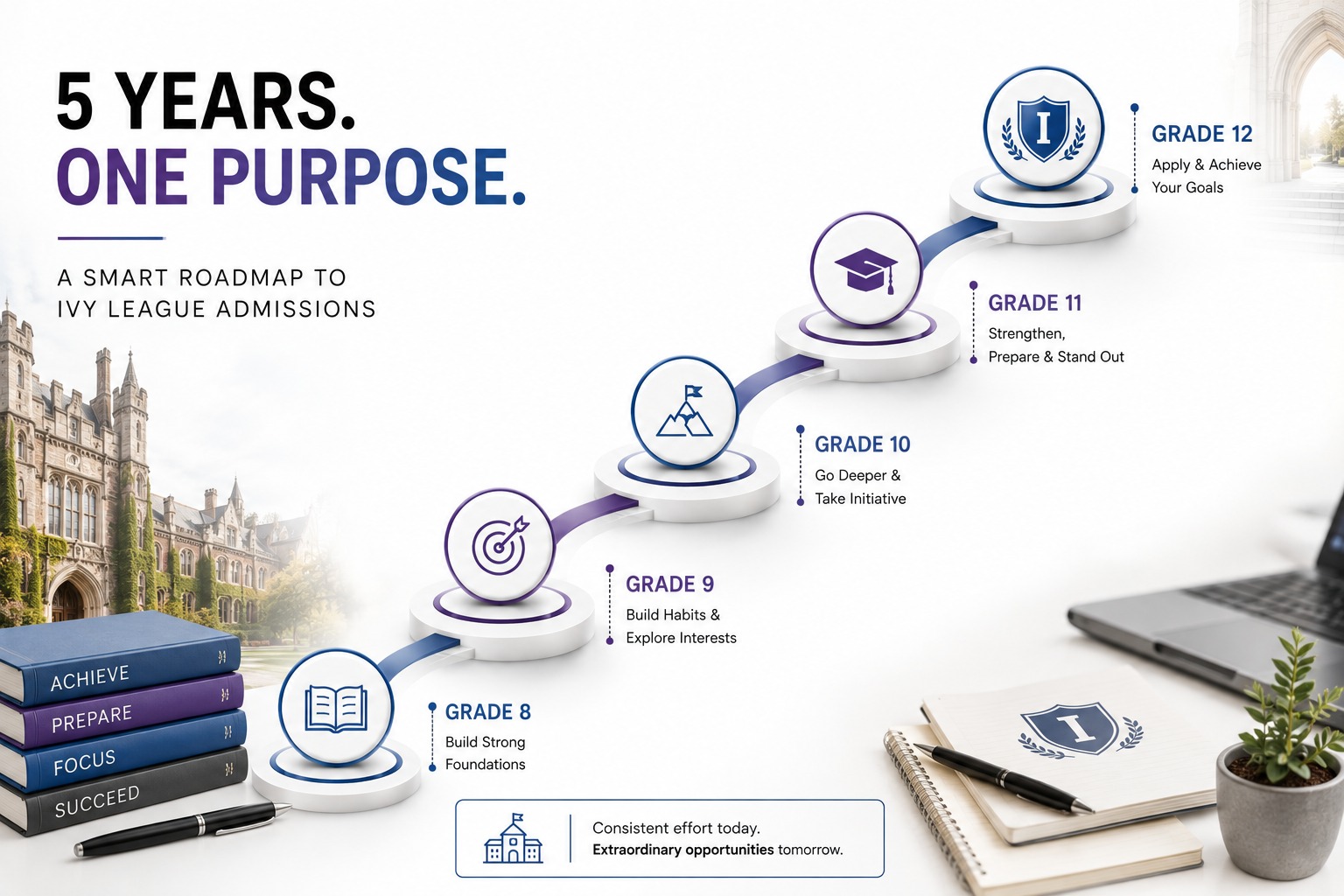
Grade 8: Build the foundations
Grade 8 should be a period of preparation, not pressure.
At this stage, parents can focus on the skills and decisions that will make high school more manageable.
Strengthen core academic skills
Reading comprehension, writing, vocabulary, algebra and basic data interpretation will support the student throughout high school. These skills will eventually help with standardised tests too, but formal SAT preparation is rarely the most important priority in Grade 8.
Encourage regular reading across fiction, history, science, current affairs and biography. Discuss what the student is reading and ask them to explain unfamiliar ideas in their own words.
In mathematics, focus on conceptual understanding rather than rushing into advanced topics without a secure foundation.
Understand the high school curriculum
Parents should learn how the school places students into advanced, honours, AP, IB or other rigorous courses.
Ask:
- Are there prerequisites for advanced classes?
- Do Grade 8 results affect Grade 9 placement?
- Does the student need to complete a summer course?
- Which subject choices may affect later academic options?
Course planning matters because selective universities assess the level of challenge a student pursued relative to what was available. Harvard, for example, advises students to pursue rigorous courses aligned with their interests and goals, while recognising that schools offer different opportunities.
Starting university research early also helps families understand the broader application timeline. For students planning to study abroad, this guide to undergraduate abroad timelines for Grade 11 and 12 students can help families keep important milestones and deadlines in view.
Let interests emerge
Grade 8 is also a good time to introduce students to different fields.
They could:
- Speak to adults working in different professions
- Watch mini documentaries or attend short workshops for a field of interest
- Read / see videos about unfamiliar and emerging careers
- Experiment with coding, writing, music, debate, design or research
- Volunteer in age-appropriate settings
The purpose is exploration. A 13-year-old does not need a fixed career plan.
Grade 9: Adjust well and begin observing patterns
The transition to high school matters. Grade 9 establishes the beginning of the academic record universities will eventually review.
The priority should be a stable start.
Help your child develop effective study habits
Students should learn how to:
- Plan assignments
- Prepare for assessments over several days
- Review mistakes and Ask teachers for help
- Manage school alongside activities – sports, MUN’s, etc
- Sleep and rest consistently
Parents can support the system without managing every task. By the end of Grade 9, the student should be taking increasing responsibility for deadlines and communication with teachers.
Choose activities with room to grow
Students do not need ten extracurricular activities.
One or two meaningful commitments can be more valuable than a crowded list of short-lived participation. Encourage your child to notice which activities they enjoy enough to continue and where they are willing to invest effort.
At this stage, participation is sufficient. Leadership titles and large independent projects do not need to be forced.
Keep a simple activity record
Maintain a document containing:
- Activity names
- Dates of participation
- Hours or frequency
- Roles and responsibilities
- Awards or recognition
- Projects completed
- Problems solved
- Lessons learned
This record will become useful when the student prepares future applications and résumés.
Grade 10: Move from participation to deeper engagement
By Grade 10, students often have a clearer sense of the subjects and activities they enjoy.
This is the time to deepen selected interests.
Review academic direction
Look at performance across Grades 9 and 10.
Consider:
- Which subjects consistently engage the student?
- Where are the strongest results?
- Which advanced courses would be appropriate next year?
- Are any academic gaps beginning to appear?
- Is the current workload sustainable?
A weaker result is not a crisis, but repeated difficulties should be addressed early through teacher support, tutoring or a change in study strategy.
Encourage initiative
A student who enjoys an activity can begin contributing beyond attendance.
For example, they may:
- Organise a small event in your building / community
- Mentor younger students for a topic where you have gained some expertise
- Develop a school publication
- Conduct a simple research project
- Build an app or website
- Create an art or writing portfolio
- Run a community awareness initiative
- Enter a few relevant competitions
The project does not need to be large or highly publicised. What matters is that the student takes ownership and learns through the process.
Begin light test familiarisation
Depending on the student’s academic level and schedule, parents can include an initial SAT or ACT diagnostic around the end of Grade 10.
The objective is to understand the format and identify broad skill gaps, not to begin an exhausting two-year preparation programme.
Parents should also review the current testing requirements of each university closer to the student’s application year, as policies differ and may change. Harvard, for example, currently requires the SAT or ACT from international applicants.


Grade 11: Build the strongest academic year
Grade 11 is often the most demanding year of high school and one of the most important in the application timeline.
Students must balance rigorous coursework, testing, activities and early college research.
Protect academic performance
The student should take a challenging but realistic course load.
Universities want evidence that applicants can handle advanced academic work. However, an overloaded schedule that leads to falling grades, poor health and abandoned commitments is rarely helpful.
Parents can support by monitoring the overall workload and helping the student make sensible trade-offs.
Prepare seriously for standardised tests
Students taking the SAT or ACT should now follow a structured plan based on a diagnostic score.
A good plan should include:
- A target testing period
- Weekly study sessions
- Focused work on weaker areas
- Timed practice
- Full-length mock tests
- Detailed error review
- Time for a possible retake
Testing should be planned around school examinations and other major commitments to reduce burnout.
Deepen activities rather than adding more
By Grade 11, the student’s main activities should show progress.
Progress may include:
- Greater responsibility
- Improved skill
- Sustained service
- Competitive achievement
- A more ambitious project
- Measurable community impact
- Research, publication or creative output
Avoid creating a last-minute nonprofit or initiative purely for the application. Admissions readers are experienced at recognising activities that lack substance or continuity.
Begin thoughtful university research
Students should investigate universities beyond rankings.
Research:
- Academic programmes
- Course flexibility or opportunity for double majors
- Research opportunities and faculty guides
- Campus culture
- Location
- Financial aid
- International student support
- Career resources
- Application requirements
Princeton recommends that applicants use the application to communicate their talents, academic accomplishments, personal achievements and individual story, not merely their statistics.
The summer before Grade 12: Prepare without rushing
This summer can significantly reduce application pressure.
Students should aim to:
- Finalise a balanced university list
- Confirm testing plans
- Build an application calendar
- Update the activity résumé
- Brainstorm personal essay ideas
- Research university-specific questions
- Identify potential recommenders
- Gather school and family information required for applications
The Common Application process involves collecting materials, adding colleges, coordinating with supporters, understanding each institution’s requirements, planning essays and submitting applications. Starting these steps early makes the process easier to manage.
Students should brainstorm essays during the summer, but they do not need to produce a perfect draft immediately.
Strong essays usually emerge through reflection and revision.
Grade 12: Present the student clearly and honestly
Grade 12 is where the earlier work comes together.
The task is not to manufacture a different personality for admissions. It is to communicate the student’s academic development, interests, choices and character clearly.
Maintain grades
Applications may be submitted during the first half of Grade 12, but academic performance still matters. Universities may review midyear and final school reports. Harvard’s application requirements, for example, include the transcript, school report, teacher recommendations, midyear report and final report for admitted students.
Students should not treat senior year as academically unimportant once applications are submitted.
Give recommenders enough time
Approach teachers who know the student’s academic work, participation, growth and character.
The student should provide each recommender with:
- Relevant deadlines
- A résumé or activity summary
- Subjects or projects they especially valued
- Possible areas the teacher may comment on
- Clear submission instructions
Parents should not write or excessively direct recommendation letters.
Write essays in the student’s own voice
An effective essay does not need the most dramatic story.
It should help the admissions reader understand something meaningful about the student: how they think, what they value, how they respond to challenges or what has shaped their perspective.
Princeton specifically advises students to tell their story and write in a style that reflects their own voice.
Parents may provide feedback on clarity, but the final essay must sound like the student.
Manage deadlines carefully
Create one calendar containing:
- Early decision (ED), early application (EA) and regular (RD) deadlines
- Financial aid and scholarship deadlines
- Testing dates
- Recommendation deadlines
- Portfolio or supplementary material requirements
- Interview preparation
- School document requests
Missing a procedural requirement can weaken an otherwise strong application.
What parents should avoid
Even well-intentioned support can become counterproductive.
Avoid:
- Comparing your child constantly with other applicants
- Selecting every activity on their behalf
- Pushing advanced courses they cannot manage
- Treating every hobby as an application opportunity
- Writing their essays
- Contacting admissions offices unnecessarily
- Focusing only on Ivy League names
- Suggesting that one admission result determines their future
Highly selective admission remains unpredictable, even for outstanding applicants.
A healthy college list should contain ambitious, realistic and safer options that the student would genuinely be willing to attend.
The parent’s role changes each year
In Grade 8, parents may lead the planning.
By Grade 10, the student should participate actively in decisions.
By Grade 12, the student should own the application, with parents providing structure, perspective and emotional support.
That gradual transfer of responsibility is important. Universities are evaluating a young adult who will soon manage academic and personal life independently.
How LilacBuds supports families through the journey
Long-term admissions planning is most useful when it remains personal and flexible.
At LilacBuds, we help students and parents understand the academic, extracurricular and application decisions that matter at each stage. This may include subject planning, profile development, career exploration, test preparation, university research, essays and the final application strategy.
The objective is not to build a standard Ivy League profile. It is to help each student make thoughtful choices, use their opportunities well and present their journey with clarity.
Frequently asked questions
Q. Is Grade 8 too early to plan for Ivy League admissions?
It is too early for intensive application preparation, but not too early to build reading, writing, mathematics and study skills. Families can also understand future course prerequisites and give the student opportunities to explore different interests.
Q. How many extracurricular activities should a student pursue?
There is no ideal number. A few sustained activities with genuine involvement, growth and responsibility are generally more meaningful than a long list of brief memberships.
Q. Does a student need a non-profit or published research project?
No. Students should not create projects merely because they believe selective universities expect them. Initiative can be demonstrated through school, community, family, employment, creative work, research or other meaningful settings. A published research project has historically proven to be a good indicator of curiosity about a chosen major, as long as it will be seen as the student’s own effort.
Q. When should SAT or ACT preparation begin?
Light familiarisation may begin in Grade 10, while more structured preparation commonly takes place in Grade 11. The correct timing depends on the student’s academic foundation, school workload and intended test dates.
Q. Can parents help with college essays?
Parents can help the student reflect, organise deadlines and review whether an essay is clear. They should not write or substantially rewrite it. The ideas, language and final voice must belong to the student.