






- How will you understand my child before advising them?
- Will my child receive a clear and personalised roadmap?
- Who will actually work with my child?
- How do you help students build a meaningful profile?
- How do you decide which universities are suitable?
- What role will you play in the essays?
- How will you keep my child involved?
- How do you measure whether the process is working?
- What support is included, and what is not?
- What should make a parent cautious?
- The final question belongs to your child
- Final thoughts
Choosing an admissions consultant is an important decision, especially when a student is applying to highly selective universities. Parents are often introduced to consultants through school groups, friends, online reviews or impressive success stories.
A recommendation can help create a shortlist, but it should not make the final decision. A consultant who worked well for one student may not be right for another. Some students need help finding academic direction and building their profile over time, while others already have strong experiences but need support presenting them clearly through their applications.
The right consultant should bring structure and informed guidance while ensuring that the application continues to reflect the student. Before hiring one, parents should ask questions that reveal how the consultant will actually work with their child.
How will you understand my child before advising them?
A consultant should not begin by recommending universities, extracurricular activities or summer programmes after one short introductory call. Good guidance begins with the student’s academic interests, strengths, extra-curricular orientation, commitments and aspirations.
One of the most common concerns parents bring to LilacBuds is that their child is academically capable but lacks a clear direction. They ask which activity or programme would strengthen the profile. Our consultants advise against beginning with the activity itself. First understand what the student enjoys, has already explored and wants to pursue in greater depth.
Ask whether the consultant will speak directly with the student and review their academics, activities and previous work. Be cautious if they decide what kind of profile your child should build before understanding them properly.
Will my child receive a clear and personalised roadmap?
Admissions consulting should have structure. Parents and students should understand what needs to happen, when it needs to happen and why it matters.
However, structure should not mean placing every student into the same sequence of activities. A future Engineering applicant may need a different academic and extracurricular plan from someone interested in Economics, Business, Psychology or Political Science. The roadmap should also change according to the student’s grade, application destination and current level of preparation.
Ask the consultant what the first three to six months will involve. A good answer should connect each recommendation to the student’s requirements. It should not simply present a standard list containing an internship, research paper, community initiative and summer programme.
Who will actually work with my child?
Parents may have an impressive conversation with a company founder or senior counsellor, only to discover that most of the work is later handled by someone else.
Ask who will be the student’s primary consultant, how much experience that person has and when senior team members become involved. If subject specialists, test-preparation tutors or essay mentors will participate, understand how they will coordinate with the main counsellor.
Too many disconnected advisors can leave the student receiving conflicting recommendations. The student needs one clear strategy, even when several specialists contribute to it.
How do you help students build a meaningful profile?
A consultant should help a student develop depth, not manufacture an application-shaped collection of activities.
Ask how they would guide a student who has good grades but no clear extracurricular direction. Would they begin by exploring interests and existing experiences, or immediately suggest prestigious programmes?
Strong profile development usually grows through progression. A student may first explore a subject, undertake independent learning, work on a project and eventually create, research, compete or contribute at a more advanced level. This is more convincing than joining several unrelated activities shortly before applications open.
The consultant should also be honest about what can realistically be achieved within the available time. Promising to create an “Ivy League profile” in a few months should be treated cautiously.
How do you decide which universities are suitable?
A university shortlist should not be based only on rankings or the consultant’s previous admits, it should rather be based on the fitment analysis.
The consultant should consider academic fit, course structure, admission selectivity, location, cost, financial aid, campus environment and the student’s likely preferences. They should also explain why each institution has been included.
Ask how the list will be divided across ambitious, realistic and relatively safer options. More importantly, ask what evidence supports those classifications. A university should not be labelled “safe” simply because another student with similar grades was admitted in an earlier year.
Admissions decisions depend on many factors, and no selective university is completely predictable. A responsible consultant should communicate uncertainty rather than give false reassurance.
What role will you play in the essays?
This is one of the most important questions to ask.
A consultant should help the student identify meaningful experiences, reflect on them, choose the right stories and improve the clarity of the writing. The final essay, however, must remain the student’s own work and voice.
Ask whether the consultant develops essays through discussion and feedback or rewrites them extensively. Also ask how many review rounds are included and whether feedback focuses only on language or also on the strength and relevance of the ideas.
An essay that sounds too polished, overly dramatic or unlike the student can weaken the application. The objective is not to make a teenager sound like a professional writer. It is to help the student communicate with greater honesty, clarity and self-awareness.
How will you keep my child involved?
Parents naturally want visibility, especially when they are making a significant investment. However, the student must remain responsible for the application.
Ask how the consultant will manage deadlines, missed work and communication. Will the student receive clear action points after every meeting? How often will parents receive updates? What happens if the child becomes overwhelmed or starts disengaging?
A good consultant creates accountability without taking over. By the end of the process, the student should understand their university choices, be able to discuss their experiences confidently and take ownership of what has been submitted.


How do you measure whether the process is working?
Admission offers are the eventual outcome, but they are not the only way to evaluate the quality of the guidance.
Ask how progress will be reviewed during the engagement. Depending on the student’s stage, this may include greater clarity about academic direction, stronger subject choices, sustained extracurricular progress, a balanced university list and completion of application milestones.
Avoid relying only on headline success rates. Such figures may not reveal the students’ starting profiles, which universities were included or how the percentage was calculated.
Instead, ask the consultant to explain how they helped particular students overcome challenges similar to those your child faces.
What support is included, and what is not?
Before enrolling, parents should understand the exact scope of the programme.
Clarify whether the service covers profile development, subject selection, testing strategy, university research, essays, recommendations, interviews, financial-aid applications and waitlist support. Also check how many universities and essay reviews are included and whether additional charges may arise later.
This is not simply a commercial question. A clearly defined scope prevents confusion at critical stages of the application.
What should make a parent cautious?
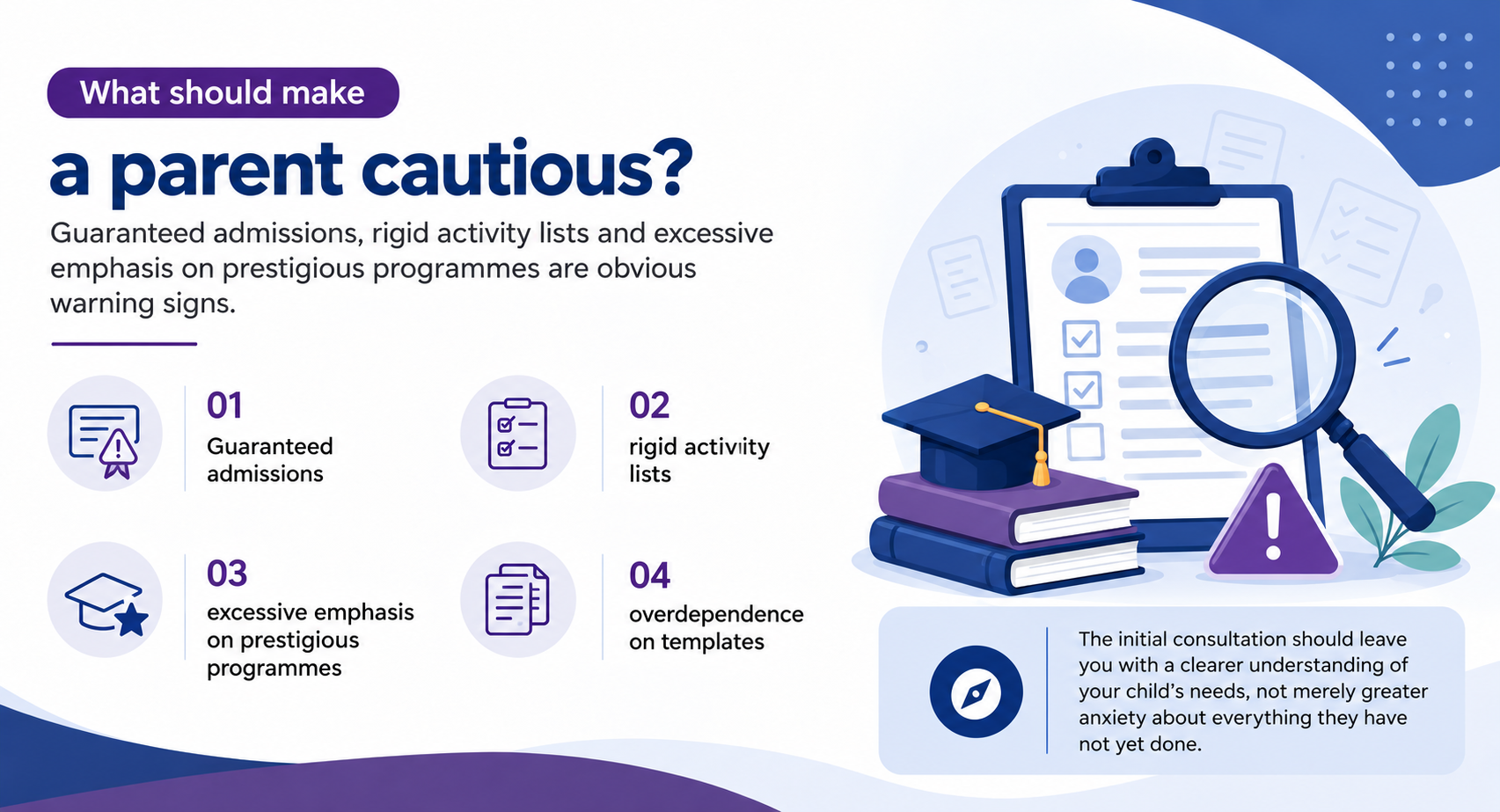
Guaranteed admissions, rigid activity lists and excessive emphasis on prestigious programmes are obvious warning signs. Parents should also be cautious when a consultant cannot explain their process, discourages direct student involvement or focuses mainly on selling a large package.
Another concern is overdependence on templates. Applications may follow a structured process, but the final strategy should not make different students sound identical.
The initial consultation should leave you with a clearer understanding of your child’s needs, not merely greater anxiety about everything they have not yet done.
The final question belongs to your child
After speaking with a consultant, ask your child whether they felt heard.
Did the consultant ask thoughtful questions? Did your child feel comfortable discussing uncertainty and changing interests? Did the conversation produce greater clarity, or did it make them feel that they needed to become a completely different person to gain admission?
The consultant should challenge the student where necessary, but the relationship must be built on trust. Students are more likely to engage honestly when they feel supported rather than judged or packaged.
Final thoughts
The best admissions consultant is not necessarily the person with the longest list of famous university admits. It is the person who can understand your child, build a realistic strategy and help them present their strongest authentic application.
Parents should look beyond referrals and success claims. Ask who will work with the student, how advice will be personalised, how essays will be handled and how the student will retain ownership throughout the process.
At LilacBuds, we work with students and families on profile development, university shortlisting, application strategy, essays and interview preparation. Speak with a LilacBuds admission consultant to understand the level of guidance that would be right for your child.