





- ISB PGP deadlines for the Class of 2028
- Is it better to apply to ISB in Round 1?
- Who should apply in ISB Round 1?
- Who should apply in ISB Round 2?
- Who should apply in ISB Round 3?
- ISB PGP eligibility requirements for 2026–27
- Is there a GMAT or GRE cutoff for ISB?
- What is ISB looking for in an applicant?
- What does the ISB PGP application include?
- How does the ISB interview process work?
- ISB fees and scholarships for 2027–28
- Final thoughts
If ISB is on your MBA programs shortlist, the application deadline is probably one of the first things you want to know.
But choosing an ISB application round is not simply about finding the earliest date and working backwards. You need enough time to take the GMAT or GRE, understand your profile, define your post-MBA goals, select the right recommender and develop essays that genuinely reflect your journey.
Applications are now open for the ISB PGP Class of 2028, with three application rounds between September 2026 and January 2027.
This guide covers the official ISB PGP deadlines for 2026–27, eligibility requirements, application components and a practical preparation timeline. More importantly, it will help you decide which round gives you the best opportunity to present a strong and well-thought-out application.
If you’re still a few months away from applying, it’s worth investing time in strengthening your overall profile before you begin writing your application. Read our guide on how to build a strong ISB profile in 6 months to understand what admissions committees value and how to improve your candidacy before the deadlines.
ISB PGP deadlines for the Class of 2028
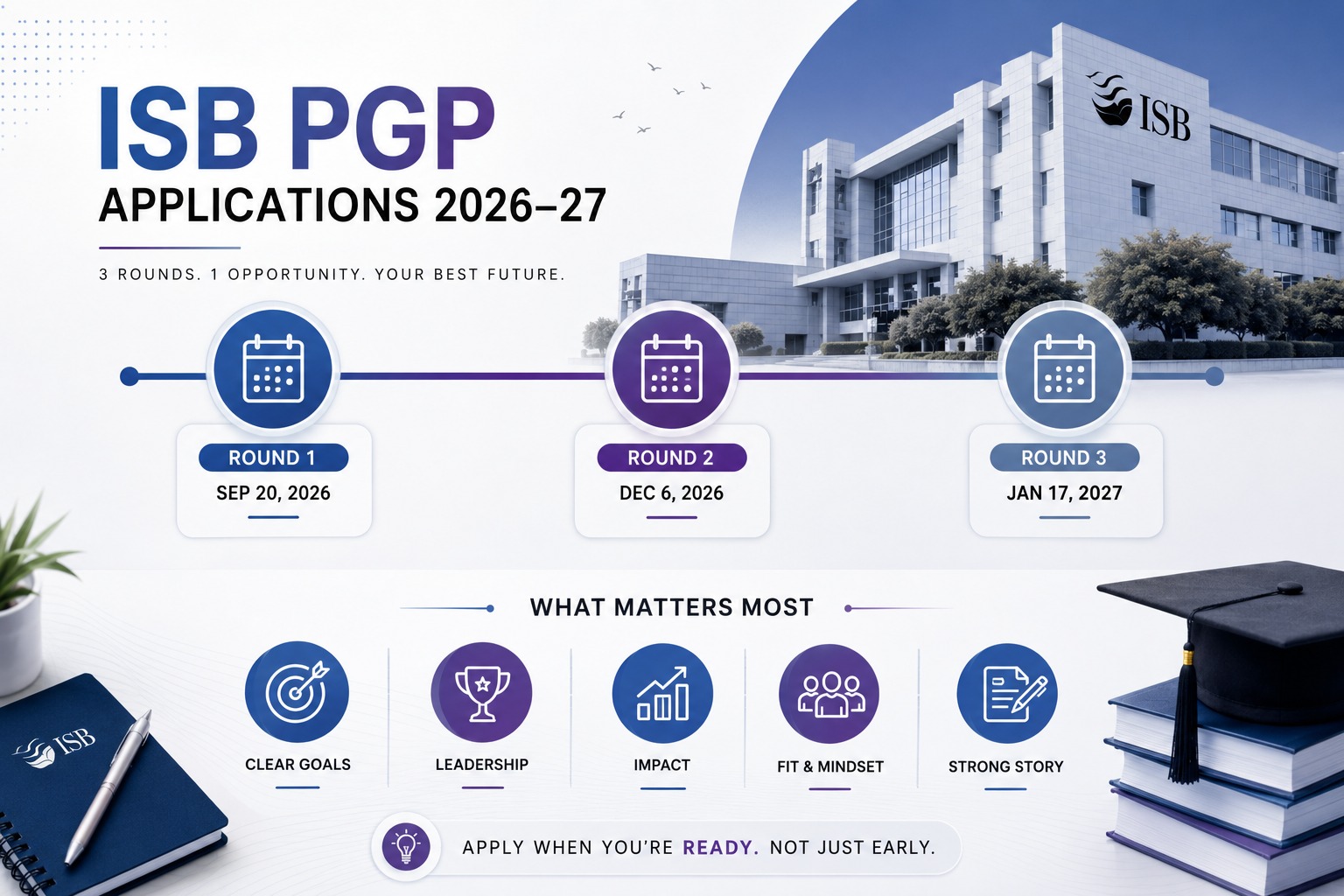
According to the official ISB PGP application deadlines, the dates for the 2026–27 admission cycle are:
| Application round | ISB PGP deadline |
| Round 1 | September 20, 2026 |
| Round 2 | December 6, 2026 |
| Round 3 | January 17, 2027 |
Candidates may submit only one application during an admission year. The three rounds are different windows in which you can apply; they are not three stages of the same admission process.
If an application submitted in an earlier round is incomplete, ISB may evaluate it in a subsequent round once it is completed. After the Round 3 deadline of January 17, 2027, the application form will close for the Class of 2028.
Is it better to apply to ISB in Round 1?
This is one of the most common questions ISB aspirants ask.
ISB states that the eligibility requirements and selection criteria remain the same across all three rounds. The school also clarifies in its PGP admissions FAQs that applying in a particular round does not significantly affect your likelihood of selection.
ISB does, however, encourage candidates to apply early because receiving a decision sooner gives them more time to plan their resignation, finances and relocation.
The important distinction is this:
Applying early can be useful. Applying before your application is ready is not.
A thoughtful Round 2 application will usually serve you better than a rushed Round 1 submission with an unclear career story, unfinished essays or a test score you know does not reflect your ability.
Who should apply in ISB Round 1?
The ISB PGP Round 1 deadline is September 20, 2026.
Round 1 may be the right choice when you already have:
- A valid and competitive GMAT or GRE score
- Clearly defined short- and long-term career goals
- Strong examples of leadership and professional impact
- A recommender who knows your work closely
- Enough time to reflect on and revise your essays
Applying in Round 1 also gives admitted candidates more time to investigate scholarships, arrange an education loan and prepare for the transition from work to a full-time residential programme.
Do not, however, choose Round 1 only because you have heard that it is “easier.” ISB explicitly states that competition is the same across the three rounds.
Who should apply in ISB Round 2?
The Round 2 deadline is December 6, 2026.
Round 2 is often a practical choice for candidates who begin preparing in the middle of the year or require additional time to strengthen one or more parts of their application.
You may benefit from applying in Round 2 if you need time to:
- Retake the GMAT or GRE (Note: The median ISB PGP class GMAT FE score is 655 and for applicants in the overrepresented pools ~675)
- Build stronger evidence of leadership at work
- Think through your post-ISB career direction
- Research the programme more thoroughly
- Develop more specific application essays
- Work with your recommender on a realistic timeline
The extra weeks between Rounds 1 and 2 can make a significant difference. They can give you time not merely to polish your writing, but to understand what your application should communicate.
One applicant we worked with, Sai Kiran, had nearly five years of experience at a public sector bank and a GMAT Focus score of 715. With only a few weeks remaining before the ISB Round 2 deadline, his initial essays leaned heavily on analytical achievements and quantitative impact. By helping him balance those accomplishments with the personal motivations and experiences behind them, we were able to craft a more authentic and compelling narrative. He subsequently received an ISB Round 2 admit and was also granted a full 100% tuition scholarship. (You can find the full video here)
Who should apply in ISB Round 3?
The Round 3 deadline is January 17, 2027.
Round 3 is the final opportunity to apply for the ISB PGP Class of 2028. It can work for applicants who begin their application journey later or need the additional weeks to complete a credible submission.
ISB confirms that candidates are considered under the same selection criteria in all three rounds. Scholarships are also available across rounds.
The practical disadvantage is not necessarily the admission probability. It is the shorter period available after admission to organise financing, leave your job and prepare for relocation.
Therefore, do not rule out Round 3 when it is the first round in which you can submit your strongest work. At the same time, avoid delaying your application until January without a genuine reason.
ISB PGP eligibility requirements for 2026–27
Before building your application plan, confirm that you meet the official ISB PGP eligibility requirements.
A Bachelor’s degree
You must hold a bachelor’s degree or an equivalent qualification from a recognised institution.
Applicants from different undergraduate disciplines are eligible. ISB does not restrict the PGP to candidates from business, engineering, finance or any other particular academic background. However we have noticed that diversity candidates – like those from medicine, law, hospitality or similar sectors do have a distinct advantage when it comes to interview selection.
Three-year bachelor’s degrees from recognised institutions are also accepted.
At least two years of full-time work experience
The regular ISB PGP requires applicants to have at least 24 months of full-time work experience as of March 31 of the joining year. This is very crucial. If you do not have the required amount of work experience, or you are in the final year of college, you can consider the PGP-YL programme instead. If you’re unsure whether ISB PGP YL or an IIM programme is a better fit for your career stage, read our detailed comparison of ISB PGP YL vs IIM to understand the key differences in eligibility, curriculum and career outcomes.
Please note the crucial exemptions that ISB makes. Any part-time employment does not count towards the 24 months work experience requirement. ISB also states that CA articleship work can add value to a candidate’s overall exposure, but it is not counted as full-time work experience for PGP eligibility.
Finally, while there is no upper bound to the ISB PGP Classroom, it is important to note that across the years the average work-ex of the ISB Cohort has been around 4 years and the range is between 2 to 12 years. Candidates with even higher work-ex can consider several other programs that ISB offers.
ISB has discontinued its earlier deferred-entry routes, including the Young Leaders Programme and Early Entry Option, in favour of PGP YL.
A valid GMAT or GRE score
ISB accepts both the GMAT and GRE for the regular PGP.
The score must be valid on the deadline date of the round in which you apply. GMAT and GRE results are generally valid for five years from the date of the examination.
ISB accepts test-centre-based GMAT and GRE scores only. Online or home-based test scores are not accepted.
Candidates who have taken the test on or before their round deadline may upload the test confirmation email and enter an approximate score in the application. The official result must then be sent directly to ISB through the appropriate test portal.
Is there a GMAT or GRE cutoff for ISB?
ISB does not prescribe a fixed minimum GMAT or GRE score.
According to the school’s GMAT and GRE admissions guidance, scores in the current class range from:
- 530 to 780 on the GMAT
- 319 to 330 on the GRE
These ranges should be interpreted carefully.
A candidate admitted at the lower end of the range may have an exceptional professional trajectory, entrepreneurial experience, unusual achievements or a perspective that meaningfully strengthens the cohort. The lowest admitted score is not necessarily a sensible target for every applicant.
Similarly, a high score does not guarantee an admit. It establishes academic readiness, but it cannot compensate entirely for generic essays, unclear goals or limited evidence of impact.
Darshil, a BITS Pilani graduate with 3.5 years of experience as a Product Analyst in the real-money gaming industry, initially viewed the MBA admissions process through a largely quantitative lens, focusing on scores, achievements and measurable outcomes. Through structured brainstorming and essay-development frameworks, we helped him uncover the personal and professional stories hidden within seemingly ordinary experiences, highlighting his leadership, initiative and impact on people around him. By transforming these incidents into a cohesive and authentic narrative, he was able to present a much more compelling application and secured admission to the ISB PGP Class of 2025.
What is ISB looking for in an applicant?
The ISB Admissions Committee evaluates more than academic scores and job titles.
On its official admissions page, ISB identifies three qualities it looks for in PGP applicants.
Analytical thinking
ISB looks for people who can identify meaningful problems, examine them critically and develop practical responses.
You can demonstrate analytical ability through academic performance, test scores and professional problem-solving. Your application may include examples of how you:
- Analysed an unclear business problem
- Used data to challenge an assumption
- Identified a process gap
- Developed a new commercial or operational solution
- Made a decision despite incomplete information
The purpose is not to make every example sound highly technical. It is to show how you approach problems and arrive at decisions.
Demonstrated leadership potential
You do not need to manage a large team to demonstrate leadership.
Leadership may appear in the way you influence colleagues, manage conflict, take ownership, support others or introduce change without having formal authority.
For example, consider the difference between these two statements:
“Managed a team of five people.”
“Led a five-member team to redesign a reporting process, reducing the monthly closing cycle from ten days to six.”
The second version gives the reader evidence of scale, initiative and impact.
Commitment to growth
ISB looks for candidates who are curious, open to feedback and capable of learning from difficult experiences.
Your application does not need to suggest that every career decision has worked perfectly. A thoughtful account of a setback, changed perspective or piece of difficult feedback can reveal more maturity than another straightforward success story.
This is also why applicants from less conventional professional backgrounds should not assume that they are at a disadvantage.


What does the ISB PGP application include?
ISB follows a holistic admissions process. The application brings together your academic history, professional journey, test score, essays, achievements and recommendation.
Academic information
You will be asked to provide details and transcripts from the undergraduate and postgraduate institutions you attended.
There is no publicly stated minimum undergraduate percentage or CGPA. ISB evaluates academic performance as one part of the wider application.
Applicants with weaker academic results should not become overly defensive. Instead, consider whether there is relevant context to provide and whether your later test scores or professional achievements demonstrate stronger academic and analytical readiness.
Employment history
Your application should explain not only where you worked but how you progressed.
Focus on:
- Promotions and expanded responsibilities
- Projects you initiated or transformed
- Revenue generated or costs reduced
- Teams and stakeholders you influenced
- Difficult situations you helped resolve
- Work that went beyond your formal job description
Use numbers wherever they make the scale of your work easier to understand. Numbers should support the story, not replace it.
ISB application essays
ISB’s essays help the Admissions Committee understand the person behind the professional information.
The exact essay questions and word limits can change, so candidates should always refer to the live application portal. Broadly, the essays are designed to uncover:
- How you think and make decisions
- What has shaped your professional journey
- How you have demonstrated leadership
- Why you want to pursue the PGP now
- What you hope to do after ISB
- What you will contribute to the class
Your essays should not become extended versions of your resume.
A strong essay usually centres on one or two specific situations. It explains the context, the decisions you made, the challenges you faced and what you learned.
Instead of writing, “I am an empathetic and collaborative leader,” describe an incident in which you had to understand competing perspectives and bring people towards a common outcome.
Recommendation
Choose a recommender who knows your work closely and can provide specific evidence of your potential.
A direct manager who has observed your development is often a better choice than the CEO or business head who knows little about your day-to-day contribution.
A credible recommendation may cover:
- How you compare with your peers
- The responsibilities you have taken on
- Your response to feedback
- Your ability to work with others
- Examples of initiative and leadership
- Areas in which you still need to grow
The best recommendations add an external perspective rather than repeating what you have already said in your essays.
Awards and activities
Professional, academic and extracurricular achievements can all contribute to your profile.
These may include:
- Promotions or internal awards
- Client recognition
- Scholarships and certifications
- Entrepreneurship or side projects
- Community initiatives
- Sporting or artistic accomplishments
- Leadership in a professional or social organisation
Do not include an activity merely to make the section look full. Select experiences that reveal something meaningful about your interests, initiative or values.
How does the ISB interview process work?
All shortlisted applicants are interviewed as part of the selection process.
ISB may conduct interviews virtually or in person. The school confirms that both formats are evaluated equally.
The interview typically lasts around 30 minutes and may be conducted by a panel consisting of faculty members, alumni and senior staff. Candidates may receive their interview invitation approximately three to seven days before the scheduled date.
Applicants are also expected to complete two on-the-spot essays during the interview process.
Your preparation should therefore extend beyond rehearsing standard MBA questions. You should be ready to discuss:
- Important career decisions
- Your role in major projects
- Leadership experiences
- Failures and lessons
- Short- and long-term goals
- Why you need ISB at this stage
- Current developments in your industry
- Information included anywhere in your application
The interview is not simply a confirmation of what you have written. It tests whether your thinking, communication and self-awareness are consistent with the application you submitted.
ISB fees and scholarships for 2027–28
The indicative ISB PGP programme fee for the 2027–28 academic year is ₹34,48,000 plus GST for shared accommodation and single-instalment payment. A refundable security deposit of ₹20,000 also applies.
The amount covers admission, commitment and tuition fees. ISB notes that the programme fee is indicative and may be revised, so applicants should check the official website before making financial arrangements.
ISB offers merit-based, need-based, diversity-based and need-cum-merit scholarships. Approximately 25% of PGP students receive financial support each year.
Tuition waivers may range from 25% to 100%. All applicants are considered automatically for merit scholarships, while some need-based and diversity scholarships require a separate essay or supporting documents.
Scholarships are available across application rounds. Applicants should therefore select their round based on readiness rather than assuming that financial aid is restricted to Round 1.
Final thoughts
The ISB application process can feel demanding because it asks you to bring several parts of your journey together within a limited space.
The goal is not to produce an application that makes you look perfect. It is to help the Admissions Committee understand how you think, what you have accomplished, where you want to go and why ISB is an important part of that journey.
Start with the three official deadlines:
- Round 1: September 20, 2026
- Round 2: December 6, 2026
- Round 3: January 17, 2027
Then choose the round that gives you enough time to submit your strongest application.
A good application is rarely created by writing faster. It comes from reflecting more deeply, choosing the right stories and bringing clarity to a journey that may currently feel scattered across several roles and experiences.
Planning your ISB application can feel overwhelming, especially when you are trying to balance test preparation, essays, recommendations and work commitments. LilacBuds’ experienced ISB consultants help applicants evaluate their profiles, identify the right application round and build an authentic, well-structured application that reflects their strengths, goals and potential.
Still deciding whether ISB is the right MBA for your career goals? Compare ISB with leading international one-year MBA programmes in our detailed guide on ISB PGP vs One-Year Global MBAs in 2026, where we compare curriculum, career outcomes, costs and return on investment.