





For a student targeting Ivy League and other highly selective US universities, strong grades in Mathematics and Science are expected. What often makes the application more memorable is what the student has done with that academic ability.
Yale makes it clear that there is no single admissions formula. Beyond academics, it considers extracurricular distinction, leadership, community involvement and personal qualities. MIT similarly looks for intellectual initiative, curiosity and exceptional ability, while assessing every student in the context of the opportunities available to them.
At LilacBuds, we often encourage students to think less about collecting STEM activities and more about developing depth in an area that genuinely interests them. In practice, strong STEM applicants often develop around five broad profiles.
1. The Research Scholar
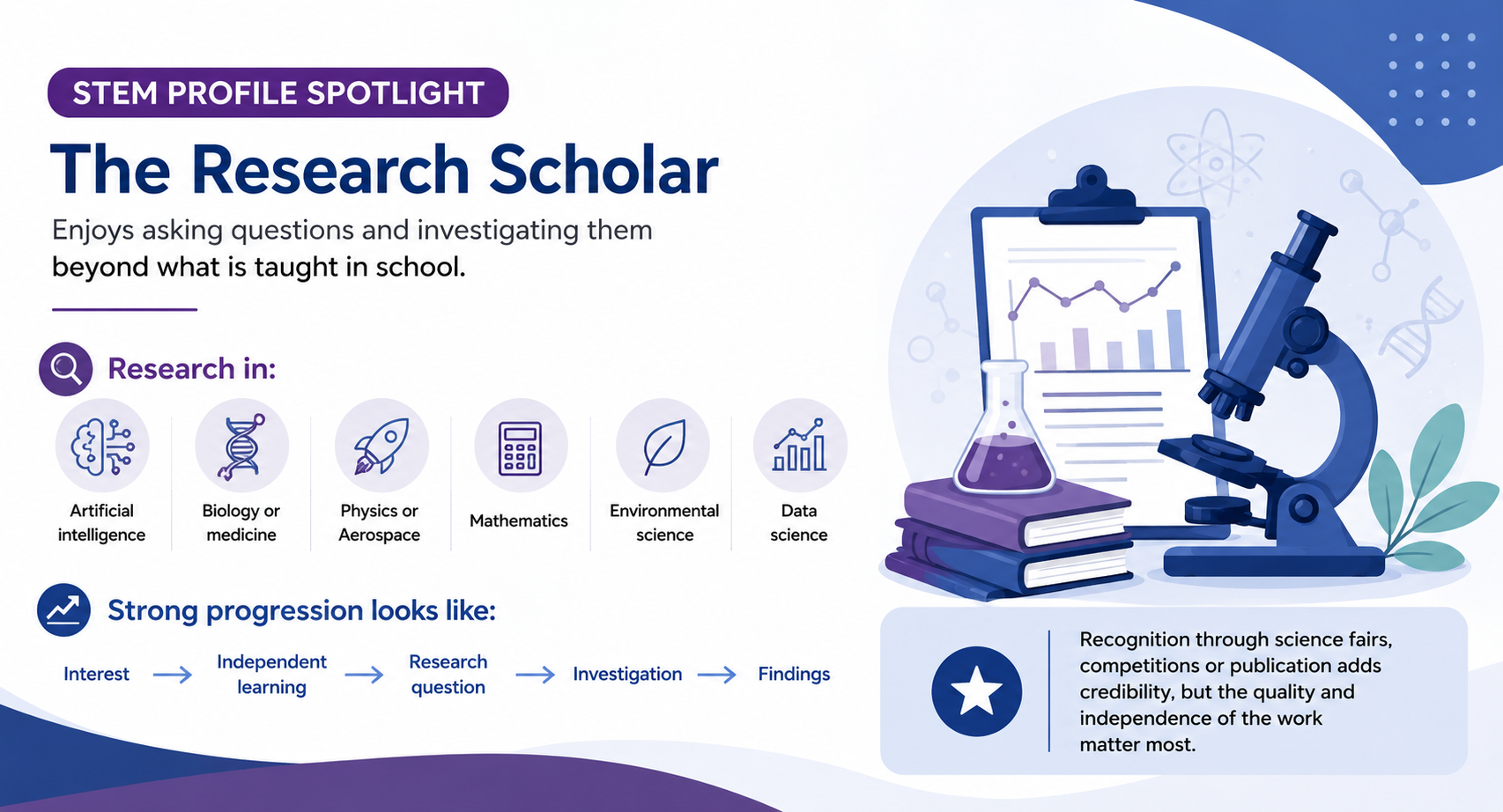
The Research Scholar enjoys asking questions and investigating them beyond what is taught in school.
This could mean research in:
- Artificial intelligence
- Biology or medicine
- Physics or Aerospace
- Mathematics
- Environmental science
- Data science
The important distinction is between participating in research and owning the research.
A student who has spent time in a university laboratory is not automatically a strong researcher. A more compelling applicant can explain the research question, methodology, findings, limitations and exactly what they contributed.
The strongest progression often looks like:
Interest → independent learning → research question → investigation → findings
Recognition through science fairs, research competitions or publication can certainly add credibility, but the quality and independence of the work matter more than the label of “research internship”.
2. The Builder or Inventor
Some STEM students are happiest when they are creating something.
They may:
- Build a robot – like FTC and FRC participants
- Develop an app that simplifies tasks or builds a community
- Design an assistive device for enabling inclusive spaces
- Create a machine-learning model to support a business
- Develop a low-cost sensor or build an engineering prototype
What makes the profile interesting is not simply that the student “built something”.
Admissions readers want to understand the purpose and true motive behind the student’s work. What problem was the student trying to solve? What failed in the first version? What did they change? Did anyone actually use the final product?
A strong ‘Builder’ profile shows technical ability alongside experimentation and persistence.
A student who spends three years taking increasingly ambitious projects from idea to working prototype will usually have a stronger story than someone with a long list of coding certificates.
3. The Olympiad Competitor
The Olympiad profile suits students who genuinely enjoy difficult academic problems.
Common pathways include Mathematics, Physics, Chemistry, Biology, Informatics and competitive programming.
At the highest levels, these competitions provide a strong external benchmark of academic ability. But students do not necessarily need an international medal for the activity to matter.
Consistent progression can itself be meaningful:
School competitions → regional level → national qualification → advanced competition
What makes this profile powerful is the depth of learning usually required behind the scenes. Olympiad students often study concepts far beyond their school curriculum and develop sophisticated problem-solving skills over several years.
Some extend the interest further by mentoring younger students, running problem-solving clubs or creating resources for other competitors.
4. The STEM Entrepreneur
The STEM Entrepreneur combines technical thinking with the ability to identify a problem people might actually pay to solve.
The student could create:
- A SaaS product or an AI-based tool
- An EdTech platform
- A health-tech solution
- A robotics product
- An environmental solution
Here, evidence matters more than titles.
A student startup becomes meaningful when there is evidence of a real well-reasoned product, genuine users, measurable traction or learning through the process. The title matters less than the substance behind it.
Some common evaluation criteria that AdComs would apply include: Did students use the platform? Did their own school pilot the product? Were there paying customers? Did user feedback evolve the product further? Was there recurring revenue or a one-off buying pattern?
Even modest numbers can tell a strong story when they are genuine.
A product used consistently by 100 people may demonstrate far more than an elaborate startup website with no real users.
5. The Public Impact Innovator
This student uses STEM to solve a problem affecting a community.
The work could involve:
- Climate or sustainability
- Healthcare
- Accessibility
- Education
- Agriculture
- Water conservation
- Public safety
- Energy
Consider a student concerned about poor air quality who learns about environmental sensors, builds a low-cost monitoring device, gathers local data and works with schools to improve awareness.
That becomes more than a science project. It connects technical knowledge with a real-world problem.
The strongest Public Impact profiles usually combine:
A genuine problem + meaningful STEM work + evidence of impact
And impact does not need to mean reaching thousands of people. Solving a meaningful problem well for a smaller community can be far more credible than creating a large campaign with very little actual engagement.
Can a student have more than one STEM profile?
Absolutely.
These are not admissions categories.
A Research Scholar might eventually turn an idea into a startup. A Builder could create technology for people with disabilities and become a Public Impact Innovator. An Olympiad student might move into advanced mathematical research.
The important thing is that the activities connect naturally.
For parents thinking about how to build this kind of profile over several years, our guide on the parent’s roadmap to Ivy League admissions from Grades 8–12 explains how academic choices, extracurricular development and profile-building can evolve throughout high school.
As we discussed in our guide to what counts as a strong extracurricular activity for Ivy League admits, depth, progression and genuine achievement usually tell admissions teams more than a long activities list.

Do not neglect the academic foundation
An impressive STEM project does not replace strong academics.
Princeton and Penn describe academic strength as their first consideration, with the high-school transcript playing a particularly important role.
STEM applicants should therefore plan their subject choices carefully and pursue the most appropriate level of academic challenge available to them.
For students following an AP pathway, our guide on which AP subjects to take for US college admissions explains how course selection can vary for Engineering, Computer Science, Data, Mathematics and other academic directions.
Which STEM profile should you build?
A better question may be: What does the student naturally keep returning to?
If they constantly wonder and ask why things happen, research may be the natural direction.
If they like ideating and making things, let them build.
If difficult problems energise them, explore Olympiads.
If they immediately think about products and users, entrepreneurship may develop naturally.
If they want science or technology to improve something around them, public-impact work may provide the strongest direction.
At LilacBuds, we advise students to start with genuine interests and then look for ways to deepen them over time. A convincing STEM profile is rarely created through one prestigious summer programme or a sudden burst of activities in Grade 11.
It develops through progression:
Learn something → explore it independently → take on a harder problem → create, research, compete or make an impact.
Final thoughts
Research Scholar. Builder. Olympiad Competitor. Entrepreneur. Public Impact Innovator.
Any of these can develop into a strong STEM profile. There is no requirement to become all five.
The aim is to develop enough depth that an admissions reader can clearly see what excites the student, how far they have taken that interest, and what they are capable of doing next.
Planning your child’s US undergraduate journey? LilacBuds works with students and families on college profile development, subject and extracurricular planning, SAT preparation, university shortlisting, and application strategy. Speak with a LilacBuds counsellor to build a structured roadmap for your child’s undergraduate admissions journey.