






- 1. Do you begin with a diagnostic assessment?
- 2. Will my child receive a structured preparation plan?
- 3. How do you adapt the pace to my child?
- 4. Does the tutor understand the digital and adaptive SAT?
- 5. What practice material will be used?
- 6. How will progress be measured and communicated?
- 7. How do you support students who experience SAT anxiety?
- Common red flags when choosing an SAT tutor
- Final thoughts
When parents begin looking for an SAT tutor, referrals are often the first step. A recommendation from another parent, a school group or a WhatsApp community can help create a shortlist. But it should not make the final decision.
A tutor who worked well for one student may not suit another. Students begin with different academic gaps, target scores, learning styles, attention spans and levels of test anxiety.
The real question is not simply, “Is this tutor good?” It is:
Does this tutor have the structure, flexibility and evidence-based approach that fits my child?
Here are the questions parents should ask before making that decision.
1. Do you begin with a diagnostic assessment?
A good SAT program should not begin with a standard lesson plan for every student. It should begin by understanding where the student currently stands.
The diagnostic assessment should help identify:
- Strong and weak subject areas – especially Math concepts
- Gaps in specific SAT skills
- Incorrect approaches to solving questions
- Difficulty managing time
- Careless errors or misreading
- Test anxiety and concentration difficulties
- Familiarity with the digital SAT format
The tutor should then study the student’s responses in detail. For example, two students may receive the same Math score, but one may need help with core concepts while the other understands the material and struggles mainly with pacing or accuracy. Their preparation plans should therefore be different.
For students currently stuck in the 1200–1350 range, it can also be helpful to understand the hidden skills needed to unlock a 1400 SAT score.
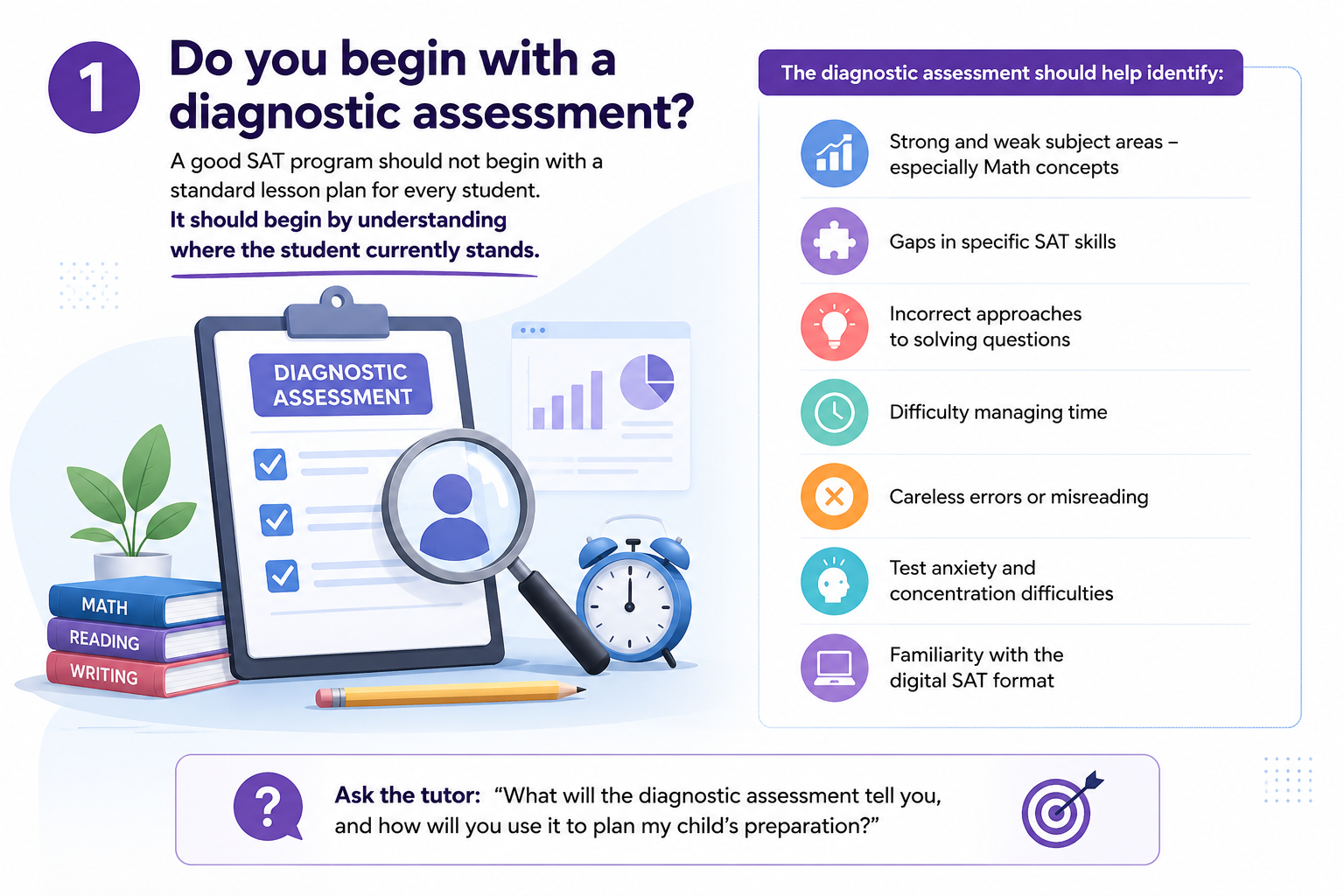
Ask the tutor:
“What will the diagnostic assessment tell you, and how will you use it to plan my child’s preparation?”
The answer should go beyond simply assigning a baseline score. It should explain how the tutor will identify patterns, prioritise areas for improvement and develop a focused study plan.
2. Will my child receive a structured preparation plan?
Personalised tutoring should also very much be structured.
The tutor should be able to explain how the programme will progress from the diagnostic assessment to concept development, guided practice, timed work and full-length tests.
A clear SAT preparation plan may include:
Diagnostic assessment → skill mapping → concept review → targeted practice → timed modules → mock tests → revision
The exact plan should vary according to the student’s needs and the time available before the test. However, parents should know what the tutor intends to cover, how progress will be measured and when the plan will be reviewed.
Most tutors are open to working backwards from the child’s planned test date, and can guide you early on the possibility of meeting the readiness level within that duration based on the diagnostic assessment conducted.
Just be cautious if the program or tutor has emphasized that they can only give a fixed number of classes or sessions, without any explanation of what those classes will achieve.
3. How do you adapt the pace to my child?
The SAT is timed, but effective tutoring is not about forcing every student to work faster immediately.
Some students understand the content but panic when a timer appears. Others rush because they are afraid of leaving a question unanswered. A few become overwhelmed by long sessions and stop absorbing feedback.
Students who struggle with pressure or exhaustion may also benefit from learning how to avoid SAT burnout and study effectively without exhaustion.
A good tutor should recognise these differences and adapt the pace accordingly.
Ask:
“What would you change if my child understands the concepts but struggles under timed conditions?”
A thoughtful tutor should be able to explain how they build speed gradually, practise decision-making and help the student recover after getting stuck.
4. Does the tutor understand the digital and adaptive SAT?
Today’s SAT is taken digitally through Bluebook. Both Reading and Writing and Math are divided into two modules, and the difficulty of the second module is influenced by the student’s performance in the first. Official Bluebook practice tests use the same multistage adaptive model. (College Board)
The tutor should therefore be comfortable teaching:
- Module-level pacing
- Effective use of Bluebook tools
- The built-in Desmos calculator
- Strategies for flagging and revisiting questions
- Time management within each module
- Practice under realistic digital testing conditions
A tutor who relies largely on outdated paper-based material may not be preparing the student for the actual test experience.
For a deeper understanding of the Reading and Writing section, parents can also explore our guide to the most-tested grammar and transition rules on the Digital SAT.
5. What practice material will be used?
Ask whether the program uses official College Board resources, including Bluebook practice tests and the Student Question Bank. However most tutors will always have their own list of preferred sources and self-developed materials to augment the Bluebook materials.
Official resources are important because they reflect the test’s format, skills and question style. Students targeting a top Math score can also explore best practices for achieving a perfect 800 on the SAT Math section. And while other materials can supplement them, but they should not replace authentic SAT practice.
Remember: More material is not necessarily better. A good tutor chooses questions for a reason. The student should understand whether a practice set is intended to strengthen a concept, address an error pattern, improve pacing or test a new strategy.
This is one area where you can ask the tutor to share a few sample worksheets for you to better gauge the quality of content and focus on sectional practice.
6. How will progress be measured and communicated?
Parents should receive more than an occasional practice-test score.
This does not require a lengthy report after every class. Even a concise and consistent update can help parents understand whether the preparation is moving in the right direction.
Ask the tutor how often progress is reviewed and what information will be shared with both the student and the parent.
7. How do you support students who experience SAT anxiety?
Test anxiety should not be dismissed as a lack of preparation. A student may perform confidently during homework and still freeze during a timed mock test.
The tutor does not need to act as a counsellor, but they should know how to create a calm learning environment and help students develop practical test-day habits.
This could include:
- Introducing timed work gradually
- Breaking larger goals into manageable targets
- Practising how to move on from a difficult question
- Using mock tests to make the format familiar
- Reviewing mistakes without making the student feel judged
- Building a test-day routine
- Helping the student distinguish between a difficult question and a poor overall performance
Parents should observe how the tutor speaks about mistakes. Does the student leave the session understanding what to improve, or simply feeling that they did badly?
The right SAT tutor should build accountability without increasing fear.


Common red flags when choosing an SAT tutor
Be cautious if a tutor:
- Promises a guaranteed score
- Uses the same plan for every student
- Does not feel the need to take a diagnostic assessment
- Conducts long lecture-style classes with little student interaction
- Focuses mainly on completing large numbers of questions
- Cannot explain how mistakes are analysed during class and after mocks
- Relies on outdated SAT formats or materials (anything older than 2 years)
- Measures progress only through total scores rather than timing and accuracy by section or topic
- Dismisses test anxiety as a motivation problem
- Cannot explain how the program will be adapted if the student is not progressing
Final thoughts
The best SAT tutor is not necessarily the person with the most referrals, the longest classes or the most impressive success claim.
It is the person who can identify what is holding your child back, explain how they will address it and adapt the preparation as the student progresses.
At LilacBuds, SAT preparation begins with understanding the individual student. We use diagnostic assessment, structured learning modules, targeted practice and detailed performance analysis to help students improve their skills, pacing and confidence.
Looking for an SAT preparation plan suited to your child’s current level and target score? Speak with a LilacBuds counsellor to understand the right way forward.